Blog
Cyber Security
The TARA Arrives, Its References Don't
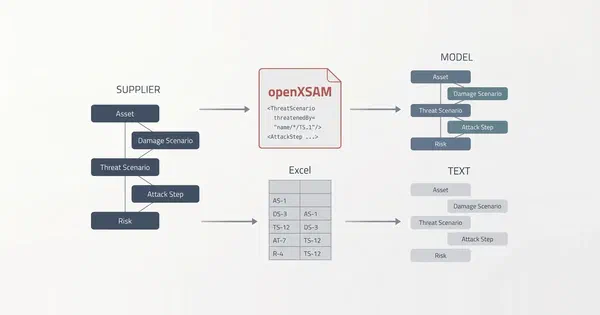
Why a TARA loses its references on the way from supplier to OEM, what openXSAM gets back, and why that takes a model.
Read Article Jens Bühl
8 min read
Holistic protection and seamless traceability for cybersecurity, functional safety, and the Cyber Resilience Act
Overview

Methodological excellence and tailored tools for model-based system and software engineering.
Overview

Enterprise software from a single source: AI integration, legacy migration and full-stack development — cost-efficiently and sovereignly hosted.
Overview

 Jens Bühl
12 min read
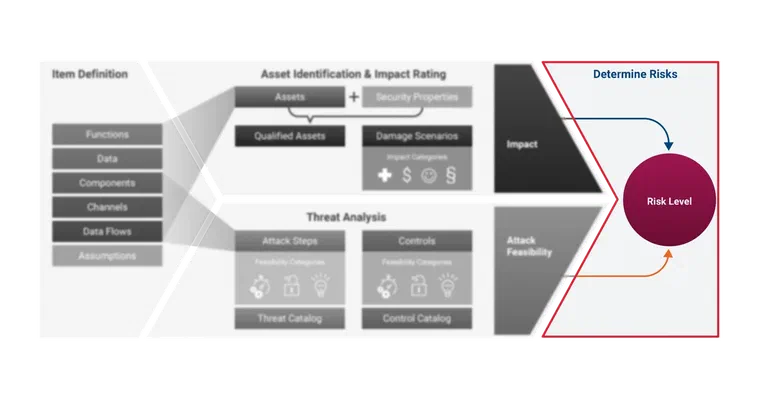
Part two of this series settled what is at stake. Part three covered how an attacker gets in and what it costs them. Now the two halves meet, and the result is a number between 1 and 5.
The number is the easy part. It comes out of a matrix that you set once. It gets harder afterwards, when you have to decide what happens to the risk. ISO/SAE 21434:2021 allows four answers: avoid, reduce, share or retain. Reduce a risk and you write a cybersecurity goal. Share it, or retain it because of an assumption, and you write a cybersecurity claim, which you then have to keep an eye on for as long as the vehicle is on the road.
This is part four of my series on the steps of a Threat Analysis and Risk Assessment (TARA). Part one covered the item definition, part two asset identification and impact rating, part three threat scenarios and attack paths.
I walk through the step using ISO/SAE 21434 and the headlamp example from its Annex H. IEC 62443-3-2 asks the same questions for industrial plants, and the section on other industries puts the two standards side by side.
Risk value. The risk value is a number from 1 to 5 per threat scenario, and 1 stands for the lowest risk. It is derived from the impact of the associated damage scenarios and the attack feasibility of the associated attack paths.
Cybersecurity goal. A cybersecurity goal is a requirement to protect assets against a threat scenario. Goals are the top level of an item’s security requirements.
Cybersecurity claim. A cybersecurity claim explains why it is acceptable to share or retain a risk.
Under 15.8, you determine the risk value of each threat scenario from its impact and feasibility. If a scenario has several paths, you may aggregate their ratings. The standard’s example uses the maximum. If the scenario is linked to several damage scenarios or impact categories, it may also get several risk values, one per impact rating. That is why Annex H writes “S: 5” rather than just “5”, meaning risk value 5 from the safety category. The standard lets you use either a matrix or a formula.
For risk treatment under 15.9, you choose at least one of four options for each scenario, taking its risk value into account:
Clause 9 sets out what follows from the decision.
The standard names no threshold here. It does not say at what risk value you have to reduce, or up to what value you may retain a risk. Elsewhere the standard only asks that no unreasonable risks remain, for example in vulnerability management and in validation in Clause 11. Where to draw that line is up to the organization.
Annex H includes an example matrix of four impact levels by four feasibility levels. Part two already noted that the negligible row has a 1 in every cell. I find the three rows above it more interesting.
The severe row has a 2 on the far left, under very low. If you adopt the matrix as it is, a scenario with severe damage never gets the lowest risk value, however much effort the attack takes.
A control that pushes a path from medium to low lowers the risk value in the major row from 3 to 2. The moderate row has a 2 under both low and medium, so the same control does not change the risk value there. Whether a control lowers a risk therefore also depends on the matrix.
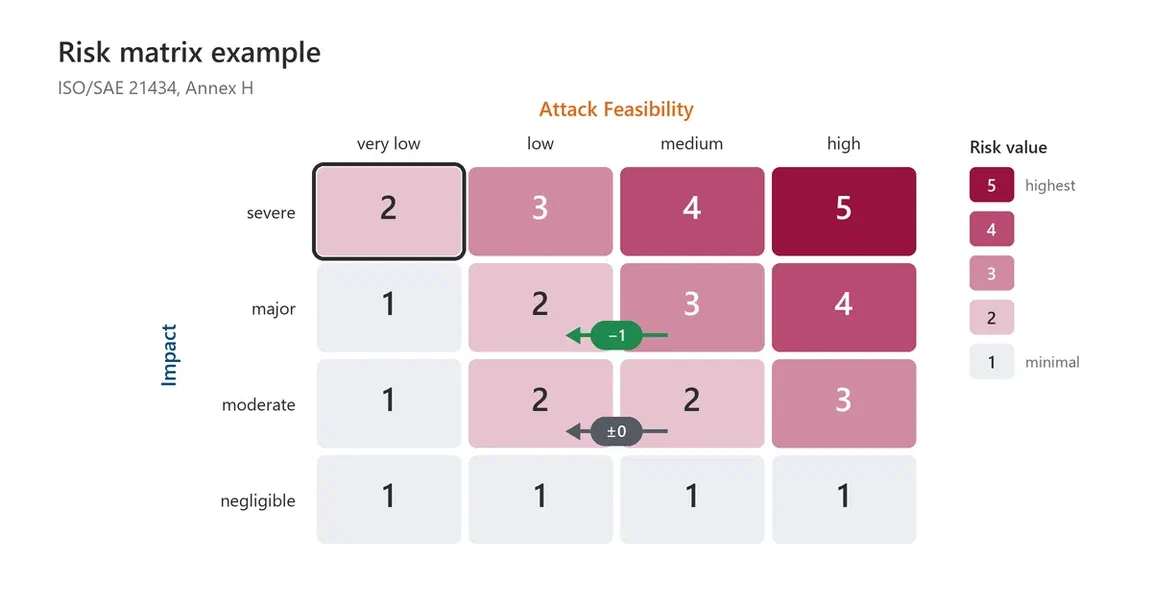
Example matrix from ISO/SAE 21434, Annex H. At severe, even very low gives a 2 (outlined). Moving from medium to low lowers the risk value by one at major and leaves it unchanged at moderate.
As an alternative to the matrix, Annex H shows a formula: R = 1 + I × F, with impact and feasibility mapped to numbers from 0 to 2. For the two scenarios in the example it gives the same result as the matrix, and the standard claims no more than that. In the remaining cells, the formula and the matrix do not always agree. Severe at very low gives 1 by the formula and 2 in the matrix. Major at medium gives 3.25, a value the matrix does not have. That is no argument against the formula. But if you switch between the two, some scenarios get different risk values.
That is why the organization should set the matrix once, just like the feasibility method from part three, and have the projects adopt it. You can start with the example matrix from Annex H. You may also use your own scales as long as they map to the standard’s (15.1). I think the matrix is the most consequential setting in the whole TARA. It is where impact rating and attack feasibility merge into one number, and every treatment decision after it depends on that number. Adjust it per project and you end up comparing risk values that look the same but mean different things.
Annex H reduces the risk in both scenarios. For the spoofing of the lamp request at S: 5, that is no surprise. The second scenario is the denial of service on the information about oncoming vehicles. It comes out at only O: 2, and Annex H still reduces it. The standard only asks you to take the risk value into account. A low value does not oblige you to retain the risk.
Avoid changes the item itself. The risk source goes away, or the activity never starts. The standard points to change management for this, and you have to update the TARA to match the changed item.
Reduce means putting controls in place against the scenario. It is the only option that leads to a cybersecurity goal.
Share moves a risk elsewhere, for example by contract or insurance, but does not make it disappear. The standard always requires a claim for sharing.
Retain does not always need a claim. The note on risk treatment in Clause 15 reads differently: it says that rationales for retaining and sharing are recorded as cybersecurity claims. The requirement in Clause 9 is narrower, though: it requires a claim for retaining only when the decision rests on assumptions made during the analysis.
I read it this way: if you retain a risk at value 1 because it is small, the requirement asks for no claim. If you retain it because you rely on an assumption, you need one. I would still give a rationale for both. In any case, the verification in Clause 9 asks whether every decision fits the result of the analysis.
Annex H supplies two such assumptions: the navigation ECU has a firewall against invalid communication from outside, and the gateway has strong security controls that were developed to CAL 4. Had Annex H retained a risk by pointing to that firewall, that would have been exactly that case, and Annex H would have needed a claim for it.
The decision determines which work product comes next. Reducing a risk requires at least one cybersecurity goal. The goal says what you have to protect. The cybersecurity concept then says how: with technical and operational controls, and with requirements on the item and on its environment. You can also determine a CAL for a goal. It sets how rigorous the later evidence has to be. At the end, validation at vehicle level checks whether the goals are adequate and achieved. Annex H, by the way, stops at the decision and does not show the goals for its two scenarios.
Sharing a risk, or retaining it because of an assumption, requires a cybersecurity claim. Cybersecurity monitoring under Clause 8 can take claims into account, and validation checks whether they still hold. Anyone reusing an item has to analyse whether the claims and the earlier assumptions still hold after the modifications.
A goal is eventually achieved and demonstrated. A claim often rests on something you do not control yourself, a contract or an assumption about the environment, and both can change. That is why I think retaining a risk because of an assumption is the most expensive decision in the long run, even though it is the least work inside the TARA.
ISO/SAE 21434 applies to road vehicles. IEC 62443-3-2 covers the same step for industrial plants, and in rail CLC/TS 50701 builds on it.
| ISO/SAE 21434 | IEC 62443-3-2 | |
|---|---|---|
| Risk from | impact and attack feasibility | consequence and likelihood |
| Threshold | none | tolerable risk |
| Reducing leads to | cybersecurity goal | target security level (SL-T) |
| Assumptions go into | cybersecurity claim | requirements specification |
The threshold is the biggest difference. IEC 62443-3-2 calls it tolerable risk, and the organization sets it. You compare the result of the initial, coarse risk assessment against it (ZCR 4), and later the residual risk after countermeasures (ZCR 5). In the end the threshold is written down in the requirements specification (ZCR 6).
I find that more honest. If your ISO/SAE 21434 TARA has a limit for retaining risk, write it down the same way, even though the standard does not ask you to.
The matrix itself fits in any spreadsheet. It needs no more than sixteen cells. It gets difficult when something upstream of the matrix changes, and when you have to show that decisions, goals and claims fit together.
You configure the matrix once. In itemis SECURE, the matrix is called the risk table. It maps the Attack Feasibility Level (AFL) and the Impact Level (IL) to the Risk Level (RL) and belongs to the assessment model. The RL is the standard’s risk value. You can store the assessment model at company level. Every project then references it and calculates with the same matrix. itemis SECURE does not prescribe which values go into the risk table.
Controls sit on the attack path. You attach a control to the threats it acts against, and the attacker has to overcome it on their path. The itemis SECURE risk engine calculates the control’s feasibility from factors, just like an attack step’s, recalculates all paths and determines the critical path, the one with the highest risk. That path gives the scenario its RL. The result shows whether a control really lowers the RL. If it only moves the feasibility from medium to low, and the matrix has the same value there, the RL stays where it was. Through the lifecycle integration, you can also link controls to verification results, so that test results feed into the RL.
You can compare variants. You group controls into control scenarios and set the results per group side by side. That shows you what a control changes about the risk, and the choice between reducing and retaining depends on exactly that.
Assumptions are objects in the model. Part two already covered this. An assumption carries a transformation that changes the damage or the effort on exactly the paths it applies to. If you retain a risk because of an assumption, you can therefore show what the claim rests on. If the assumption no longer holds, you take it out, and itemis SECURE recalculates which risks shift.
The verification in Clause 9 asks whether decisions, goals and claims are complete, correct and consistent with each other. So it checks relationships: from scenario to decision, from decision to goal or claim, from claim to assumption. In a spreadsheet those are cross-references between sheets that someone has to maintain by hand. In a model they are links that are either there or missing, and you can search for the missing ones.
An AI assistant is good at proposing controls, because there are catalogues and plenty of public material for that. But I would not let it decide to retain a risk. That decision carries a rationale someone has to stand behind later, in the audit and in monitoring. That is why itemis SECURE versions every proposal from an assistant and records where and when it was made. A human accepts, modifies or rejects it.
In part three, a new CVE raised the feasibility of the affected paths. The matrix turns the higher feasibility into a new risk value, and a risk you retained at 2 suddenly sits at 3. For every vulnerability, the standard requires you to assess and treat the risk under 15.9 until no unreasonable risk remains, or to eliminate the vulnerability with an available remediation such as a patch. So your treatment decisions from the concept phase come up for review again with every new vulnerability. itemis SECURE takes you from the CVE through the affected components and threat scenarios to the risks. You see which ones have shifted and which decisions you need to look at again.
The risk value is quick to determine once impact and feasibility are in place. The matrix you settle on beforehand has more consequences, and the decision you have to justify afterwards is harder.
My takeaway is that the organization should set the matrix once and in writing, and that the matrix helps decide what counts as a reduction. ISO/SAE 21434 names no threshold for retaining, and IEC 62443-3-2 requires one. Write down your own, whichever standard you work to. If you reduce a risk, you need a goal. If you share it, you always need a claim, and if you retain it, you need one only when an assumption stands behind the decision. You have to keep an eye on a claim for as long as the item is in the field.
If you want to put this into practice in a model: the itemis SECURE risk engine calculates every attack path, determines the critical path and derives the Risk Level from it. Controls and assumptions are objects in the attack path, and as soon as paths, controls or assumptions change, the engine recalculates. If you would like to see what that looks like on a real item, reach me on LinkedIn or via itemis.com.
This part completes the series on the steps of a TARA. For an overview of the whole method, see my introductory article What Is a TARA?.
Where do you draw the line above which you have to reduce a risk? Is it written into a policy, or do you decide that per project?
Cyber Security at itemis — Systematic security engineering for automotive, IoT and Industry 4.0: Cyber Security →

Product Owner
Why a TARA loses its references on the way from supplier to OEM, what openXSAM gets back, and why that takes a model.
Read Article
Jens Bühl
8 min read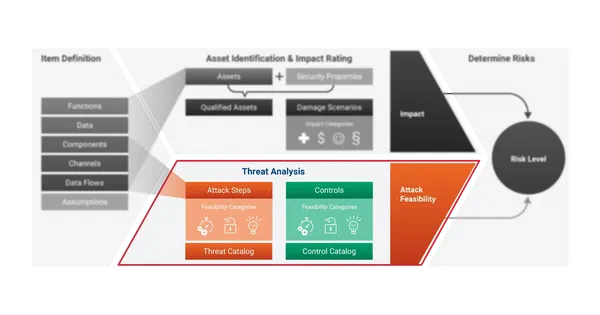
Threat scenario, attack path and attack feasibility belong together: what makes a scenario, why the path gets rated, and how the method shifts the result.
Read Article
Jens Bühl
13 min read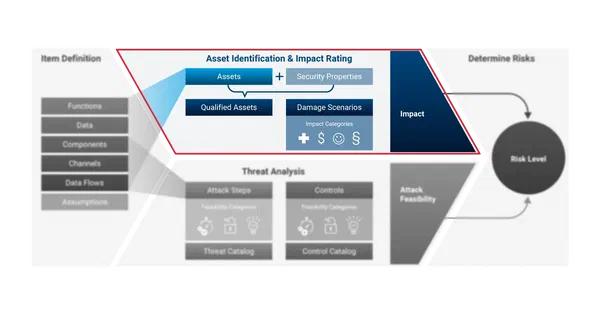
Asset identification and impact rating supply one half of the risk value: when an element of the item becomes an asset, whose damage a damage scenario describes, why the safety rating is not security's to set alone, and what keeps ratings comparable across projects.
Read Article
Jens Bühl
15 min read