


AI-driven Development: Why Technology Is Only Half the Battle – and How Aimlessness Leads to Failure
 Holger Schill
4 min read
Holger Schill
4 min read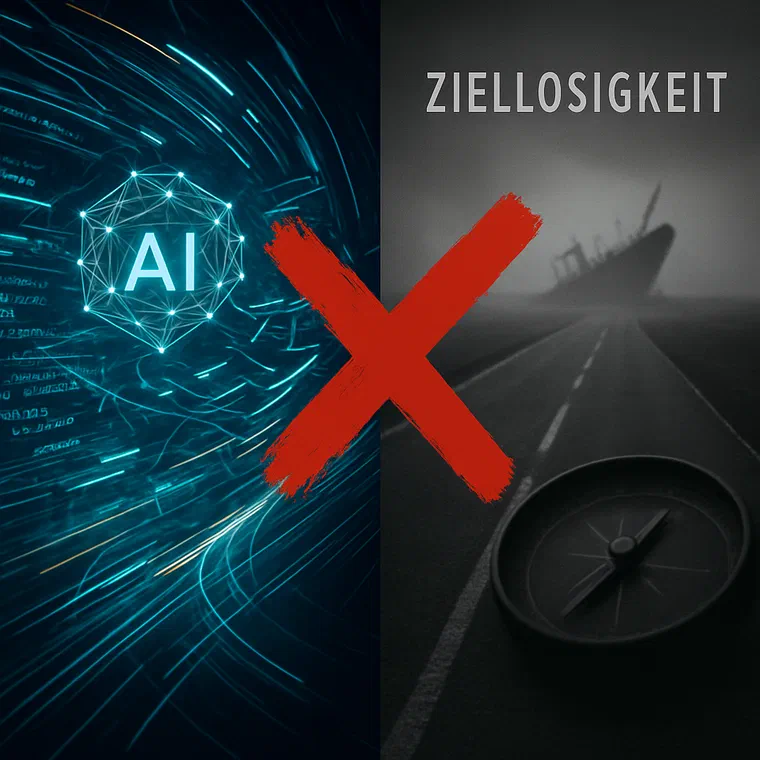
We Talk About the “How” Before Clarifying the “What For”
Let’s talk today about the biggest misconception in AI-assisted software development. In almost every conversation, at every conference, everything revolves around the technology: Which framework, which model, which tool?
This fascination is understandable. The temptation is enormous to dive straight into “vibe coding” – hacking prototypes with the latest LLMs. But that is exactly where the greatest danger lurks. We discuss cutting-edge technology before we have spent even a minute talking about the actual business goals.
The core message is hard, but I see it confirmed in practice time and again: AI-driven development rarely fails because of the code. It fails because of aimlessness.
The Path from Cool PoC to Business Impact
I make a provocative claim: 90% of all AI projects are doomed to fail from the very start. Not because the technology isn’t powerful enough today – quite the opposite. But because the foundations are simply wrong.
Teams start enthusiastically, build pipelines, and after a few months the result is always the same: a technically impressive proof of concept. But zero business impact.
The decisive difference between a tech demo and a productive, value-creating system is goal clarity.
The typical pitfalls I encounter in projects time and again:
- ❌ No clear goals: “We need to do something with AI” is not a strategy. There is no clean definition of what concrete value the AI should deliver to the business or the development process.
- ❌ Data quality unclear: Without reliable, well-prepared data, every model is blind. Especially in legacy system migration, it becomes clear that AI can only work as well as the foundation it is given – structured and comprehensible.
- ❌ No shared understanding: Business and tech often talk past each other. The product owner’s expectations of AI performance and the technical feasibility are far apart.
- ❌ Missing metrics: Nobody knows what success actually means. How do we measure the benefit? In lines of generated code? Or in reduced technical debt, higher test coverage, or improved maintainability?
If these questions remain unanswered, even the most modern tooling is useless. The project is lost long before the first commit is made.
The Key: Focus on Behavior, Not Code
The real starting point is not in the code, but in clarity about goals, data, and expectations.
Many people talk about AI tools, but hardly anyone talks about what is truly needed: models that can understand software – rather than merely interpreting it. The key lies in describing software in a way that AI can comprehend and reproduce.
This is exactly where our approach BMAD (Behavior Modeling for AI-driven Development) comes in: instead of walls of text or half-baked user stories, we work with precise, machine-readable models that describe what behavior a system should exhibit.
- The result: Software that is explainable, verifiable, and reproducible. This is how we move AI-driven development out of the experimentation phase and toward a reliable, scalable application.
Human-AI Collaboration: The New Role of Architecture
Many fear that software architects will become redundant once AI generates code. Wrong – the opposite is true.
Architecture is more than simply assembling frameworks and libraries. AI can already handle that detail work today. What matters are the major decisions:
- Designing systems to be secure and scalable.
- Thinking about governance and risks from the very beginning.
- Balancing the trade-offs between performance and security.
Without architects, AI would produce massive amounts of code – but equally massive amounts of chaos. The role shifts: away from code details, toward decisions about structure, responsibility, and interplay. The more AI intervenes in implementation, the more indispensable the architecture that holds the compass becomes.
Our Methodology: Advanced Context Engineering
At itemis, we address aimlessness with a clear methodology: Advanced Context Engineering (ACE). It is the art of guiding LLMs to solve complex tasks by deliberately structuring the context.
This includes the use of architect and orchestrator modes and deep research, to ensure that AI does not code blindly, but acts on the basis of a solid, human-validated foundation. The human remains actively in the loop: reviewing, correcting, and directing. Because: AI can generate code, but takes no responsibility. Without the human, it has no orientation whatsoever.
Conclusion: Humans Without AI Are Too Slow, AI Without Humans Writes No Solutions
The discussion revolves too often around the wrong question: Does AI replace the developer – or not? Both are wrong. The future belongs to collaboration.
Only in combination does software emerge that is fast, robust, and trustworthy. My advice: at the start of every project, ask yourself radically honestly, “What are we doing this for?” The first commit is not the beginning of an AI project. The starting point lies much earlier – in radical goal clarity.
AI Enablement at itemis — From strategy to implementation: AI Enablement →

Executive Vice President Cloud & Enterprise