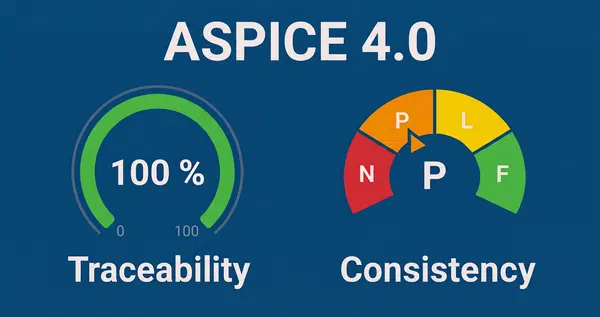
Requirements traceability describes the continuous chain linking requirements, architecture, system design, software, hardware, tests, validation, security controls, releases and updates. It forms the digital compliance structure of modern development.
Standards such as ISO 26262, IEC 61508, ISO/SAE 21434, IEC 62443 and the Cyber Resilience Act all require traceable relationships between requirements, implementation, tests and validation.
In practice, traceability frequently fails due to fragmented tool landscapes: requirements reside in DOORS or Polarion, architecture models are created in MBSE tools, development runs in GitLab, tests are managed separately. Gaps form between these systems, and with them, traceability is lost.
A Traceability Information Model (TIM) defines which artefacts must be connected and how changes can be traced throughout the entire development process. TIMs are versioned: assertions in the traceability graph carry provenance to the TIM version against which they were validated. This structure makes traceability not only auditable but reason-ready for AI-supported analysis.
Compliance vs. value: where is the real return?
Companies typically introduce requirements traceability for one of two reasons:
- Compliance-driven: To pass audits, prepare for ASPICE assessments or demonstrate standards conformance. The risk: traceability becomes a pure documentation obligation with no real engineering value. → Compliance Intelligence
- Value-driven: To sustainably improve quality and efficiency. The focus is on early fault detection, consistent impact analyses and cross-system change traceability.
Our experience in practice: a purely compliance-driven traceability project rarely pays off. Only the value-driven approach delivers the real return, and fulfils compliance as a natural by-product.
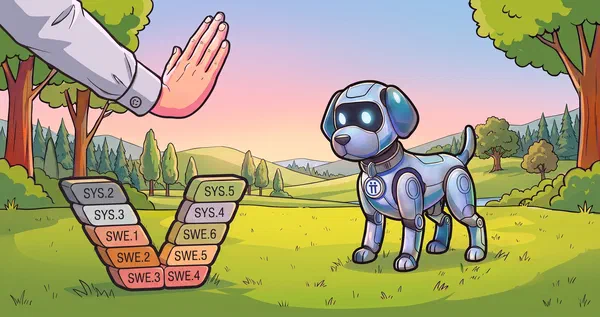
One principle applies throughout: AI accelerates analysis, not decisions. Deterministic traceability forms the reliable foundation for AI-supported semantic analysis and explainability. Approval, governance and accountability remain with people, not in autonomous automation.




 Pierre Dammé
6 min read
Pierre Dammé
6 min read