At the heart of many custom tools is a domain-specific language (DSL): a notation in which experts work in their own vocabulary. Rules and best practices are not documented but structurally enforced. Knowledge that today resides in the heads of your experts is encoded in the metamodel and thus implicitly available.
DSLs define the vocabulary and even encode the methodology itself. Which concepts exist in the language, which relationships are permitted, which constraints apply: that is the methodology, translated into executable language constructs. A well-designed DSL makes it structurally easy to work methodically correctly and structurally difficult to work incorrectly.
Domain languages can be textual, tabular or graphical — developed with specialised language workbenches such as Xtext or JetBrains MPS, or embedded into modern integration platforms such as VS Code via the Language Server Protocol.
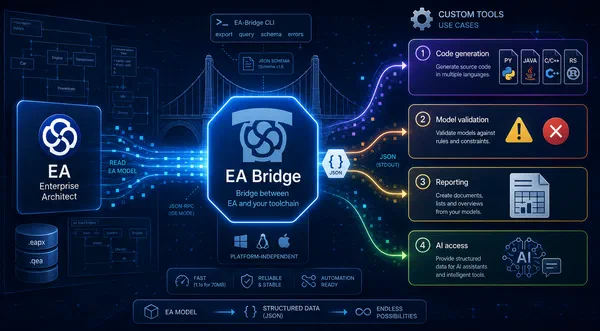
Not every custom tool starts on a greenfield. Many standard tools (e.g. Enterprise Architect, Rhapsody, Capella) offer extension mechanisms through which additional functionality can be integrated without replacing the tool. Such extensions are also custom tools: tailor-made, domain-specific, adapted to your process.
The same principle applies to the modelling language itself: generic languages such as UML do not need to be replaced by a new DSL if they can be adapted precisely enough to a methodology through profiles. Stereotypes define domain-specific concepts, tagged values structure metadata, constraints enforce methodical rules, without replacing the base tool. In an automotive tier-1 and a medtech project, we deliberately advised against a custom DSL after the domain analysis and instead used UML with a project-specific profile. The result was a methodically precise environment with minimal tool change.
Custom tools are not a universal remedy. They pay off where a small group of highly specialised experts works with concepts that no standard tool adequately represents. For large, heterogeneous user groups with generic requirements, standard products are usually the better choice.
The core question: do the abstractions and functions of an existing tool fit your domain well enough? If so, use it. We also recommend our own products such as itemis CREATE or itemis ANALYZE where these are a better fit than a custom tool.
In over 20 years, we have learned: not every domain needs its own language. For an automotive tier-1 supplier and a medtech company, we deliberately advised against a custom DSL after the domain analysis, as UML was sufficient. Instead, we successfully integrated the UML tool into the respective toolchain.
Structural advantages at a glance: Domain knowledge in the tool · Validation while typing · Consistent generation · Integrated simulation · No vendor roadmap dependency · Knowledge stays within the organisation