Model-Based Systems Engineering

Master complexity. Accelerate innovation.

System complexity is growing. Market cycles are shortening. Classic, document-centric development is hitting clear limits. Model-Based Systems Engineering (MBSE) replaces isolated spreadsheets with a consistent, living system model and becomes the decisive lever for faster innovation cycles and fewer development risks.

Fundamentals

What is Model-Based Systems Engineering?

Model-Based Systems Engineering (MBSE) replaces document-centric development with a consistent system model. Instead of maintaining requirements in Word documents and recording architecture decisions in PowerPoint presentations, a model is created that keeps system behaviour, structure and requirements in a semantic context.

The philosophy behind it: the digital model is the single source of truth, not the static document. All disciplines work on the same, interconnected representation of the system. Changes are immediately transparent and traceable for everyone.

MBSE is a means of making complex systems manageable and conducting evidence chains more efficiently.

Compliance vs. Value

Why companies introduce MBSE and where the real value lies

Companies typically introduce MBSE for one of two different reasons.

Compliance-driven: To meet stringent industry standards such as ISO 26262, ASPICE or DO-178C. The risk: MBSE degenerates into a purely bureaucratic obligation with no real benefit.

Value-driven: To sustainably improve quality and efficiency. The focus is on early model validation, error-free impact analyses and cross-disciplinary reuse of components.

Our recommendation is the value-driven entry: it delivers the actual return and covers the compliance requirements at the same time.

Economic Value

Where MBSE saves time and money

The economic value of MBSE can be measured in three clear levers — all three are regularly achieved in customer projects.

Shorter time-to-market

Errors in requirements are not discovered at the expensive hardware prototype stage, but simulated and resolved months earlier directly in the model. A classic shift-left approach.

Lower change costs

A change request? The digital impact analysis shows at the push of a button which software components, test cases and hardware interfaces are affected, preventing costly downstream errors.

Efficient reuse

System components modelled once can be seamlessly adapted for the next product generation or other variants. Product line engineering based on a structured model.
From practice

Two examples from our project work

Automotive Tier-1: Safety analysis automated from the system architecture

For a leading automotive supplier, we used MBSE to build the decisive bridge between the system architecture and the processes of functional safety. Based on a model-based system analysis and complete requirements traceability, the System FMEA could be derived seamlessly from the system architecture and built in an automated fashion.

The safety analysis is now 100% consistent with the real architecture at all times. Manual, error-prone reconciliations are eliminated entirely. Development efforts for ISO 26262 compliance were drastically reduced and release cycles massively accelerated. → Reference: FORVIA HELLA

Mechanical and plant engineering: MBSE introduction in a mid-sized company

Together with a mid-sized mechanical and plant engineering company, we piloted the introduction of model-based development. The previous document-based approach had no defined method for separating the problem side (stakeholder requirements, laws and standards) from the technical solution side. Technical solutions were therefore often uncritically carried over from existing projects, which blocked innovative further development.

Through the introduction of a multi-layered architecture, we were able to sharpen the responsibilities of all clients, ensure compliance with laws and industry standards, and document technical decisions in a traceable manner. Training employees anchored this new way of thinking as a long-term success pattern in the company.

Honest Assessment

When does MBSE not fit?

MBSE is not a universal remedy. It delivers no value when the framework conditions are not right.

Small projects with low complexity. With manageable interfaces, a small team and no variants, the initial effort exceeds the later benefit. A company developing an isolated control unit for an existing machine is simply faster with document-based coordination.

Unstable organisations. MBSE cannot heal structural deficits: unclear responsibilities, chaotic change management. When requirements are changed informally on an ad-hoc basis and there is no functioning configuration management, MBSE digitises the chaos without resolving it.

Lack of commitment. Without active management support and the team’s willingness to leave familiar document silos behind, the methodological culture change fails. MBSE requires time for onboarding, and the company must consciously allow for it.

Our experience from over 18 years of project practice: a purely compliance-driven MBSE rarely pays for itself. Only the value-driven entry delivers the real return — and fulfils compliance automatically as a by-product. If MBSE is still too early for your current maturity level, we will say so.

Self-check

Does MBSE fit your current situation? Five questions for an initial assessment

These questions from our project experience help you with an initial orientation.

1. Complexity: Is our development task sufficiently complex, both in terms of the product structure and the large number of responsibilities and disciplines involved?

2. Change dynamics: Do we have high dynamics in requirements and need to analyse the impact of changes across disciplinary boundaries quickly and without errors?

3. Management support: Is senior management fully on board with this cultural change and actively freeing up the necessary resources and budgets for the transition?

4. Team readiness: Is the development team willing to leave familiar document silos behind and embrace new, interconnected ways of working?

5. Process foundation: Are our fundamental processes and responsibilities within the company clarified, or do we need to restructure procedures in parallel?

Why now?

Three waves making MBSE the standard

Regulatory pressure

CRA, ISO 26262, ASPICE, DO-178C: new legislation makes gapless architecture evidence unavoidable. MBSE provides the data foundation for safety and cybersecurity analyses that cannot be produced in a legally sound manner without a consistent model. → Functional Safety

Topic

Compliance & Functional Safety

Cost and complexity pressure

Outsourcing and globalisation no longer reliably reduce costs. Optimisations must happen internally. MBSE makes hidden dependencies visible and creates transparency for efficient, variant-reduced product development.

Topic

Efficiency & Variant Management

New technological enablers

SysML v2 lowers the entry barrier with standardised APIs and vendor-independent implementation. LLMs with access to model and requirements data create the digital thread; agentic workflows reduce mechanical tasks to a minimum.

Topic

SysML v2 & AI Support

Methodology Selection

Tailoring the right modelling approach

There is no single correct modelling approach — there is only the one that suits your project. Together, we analyse the concrete framework conditions based on four key questions: What competencies already exist? What tools and processes are in use? What core problems are in the foreground? And what thinking patterns characterise your team?

We provide fully vendor-independent support — whether a technological migration from SysML v1 to SysML v2, the introduction of Capella or Arcadia, or the development of custom domain-specific languages. Co-authoring CONSENS for mechanical engineering and developing ArchE for CARIAD are among our references. → Custom Tooling & Domain-Specific Languages

Success depends on the precise application of the method, not on the method itself.

Tool Selection

Selecting the right toolchain

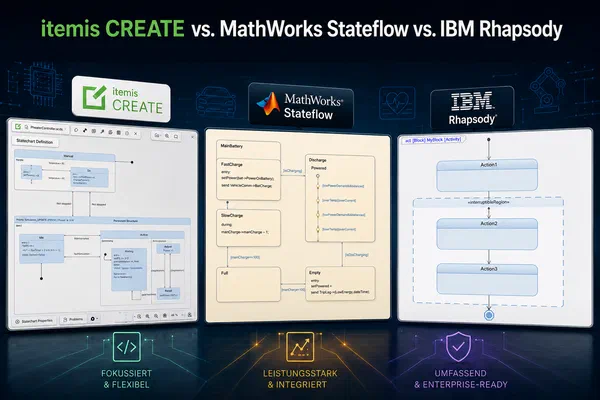
Selecting the right tools determines whether MBSE is lived efficiently in practice. We support you vendor-independently in selecting the appropriate modelling tool, whether you want to use a language standard like SysML (CATIA Magic, IBM Rhapsody, Sparx Enterprise Architect, MathWorks SystemComposer), aim for a specialised approach (Capella, PREEVision, SpicySE, itemis CREATE) or wish to have a modelling tool developed individually by us.

We are convinced of the advantages of a “best-of-breed” strategy, i.e. selecting the best tool for each specific task. However, we always evaluate this approach strictly on a customer-specific basis: the supposedly best requirements tool on the market with complex collaborative workflows delivers no added value if only two people work with it in the end. In such cases, the supposedly “inferior” but already seamlessly integrated standard solution is often the more economical and efficient choice.

At least as important as the tool selection is the seamless integration of the toolchain. With itemis ANALYZE we offer a proven platform for connecting model-based tools to higher-level ALM and PLM systems, from IBM ELM, Siemens Polarion, PTC Codebeamer/Integrity to Jama Connect. Where standard adapters fall short, we develop custom integration solutions. → Reference: I.G.Bauerhin: 70% more efficient through itemis ANALYZE

More on toolchain integration: Toolchain Integration & Tool Selection

The concrete need and methodology determine the tool, not the other way around.

Assessment criteria

What really matters in tool selection

To find the optimal balance between specialisation and simplicity for you, we evaluate tools based on four strategic criteria.

Take existing investments seriously

A migration is often more expensive and risky than cleverly adapting existing systems. We build on what you have and only then assess whether a switch is truly worthwhile.

Prioritise open data formats

Interoperability through standards such as ReqIF, OSLC and SysML/XMI keeps the toolchain flexible and prevents one tool decision from forcing the next.

Consciously manage vendor lock-in

Dependency on a single tool vendor should be a conscious strategic decision, not an accident. We earn no tool referral commissions.

Licence model matched to user profile

The best requirements tool on the market delivers no value if only two people work with it. The licence structure must match the actual user profile — this is often more decisive than the feature set.
Architecture principles

The bridge to the overall architecture: three principles

Whether an all-in-one solution or a networked “best-of-breed” landscape: to create a consistent overall architecture, we follow three clear principles.

Single source of truth per data type. Each piece of data (a requirement, an architecture element) has exactly one clearly defined point of origin.

Continuous traceability layer. Connections between tools must be traceable without gaps. With itemis ANALYZE we offer a vendor-independent layer for this purpose that links data across system boundaries. → Requirements Traceability

Synchronisation instead of duplication. Data is intelligently synchronised or linked between systems, rather than being blindly duplicated and thereby creating sources of error.

Our approach

Introducing MBSE: how itemis proceeds

The successful introduction of Model-Based Systems Engineering is a structured, transparent process.

1. MBSE Maturity Assessment & Goal Definition. Directly in the project kick-off, we jointly analyse your current maturity level. We review the current state of your development processes and define a clear, shared target picture, backed by measurable KPIs, so that success remains steerable from the very beginning.

2. Tool-agnostic tailoring of the methodology. Standard frameworks such as RFLP provide a good basic structure, but rarely fit your reality one-to-one. We tailor the methodology, independent of any tool, precisely to your project and your company. Our focus is on recipient-oriented outputs that create immediately measurable added value for your systems development.

3. Accompaniment in the pilot project. We accompany you in a suitable pilot project directly in day-to-day operations: professionally in concrete modelling and practically in the introduction and correct use of new tools.

4. Scaling & roll-out. After the successful pilot, we broaden the approach. We support the roll-out to further projects and departments on request through active involvement directly in your architecture development.

Accompanying enablement: training your teams. A new process only works if the people master it. In parallel with all steps, we train the staff involved through targeted training in the fundamentals of MBSE, modern requirements engineering and the use of AI in everyday engineering.

Our Experts
Dr. Alexander Nyßen

Executive Vice President Digital Engineering · itemis AG

Dr. Alexander Nyßen has specialised in Model-Based Systems Engineering (MBSE), model-based development and the integration of engineering tools since 2003. He supports companies in successfully introducing and sustainably establishing model-based methods and tool landscapes for the development of complex cyber-physical systems. In strategic product management, he is responsible for itemis ANALYZE and itemis SECURE, with a focus on requirements traceability, functional safety and cybersecurity.
Benjamin Alders

Principal Systems Engineer · itemis AG

As Principal Systems Engineer at itemis, Benjamin Alders focuses on MBSE, Functional Safety, ASPICE, and the use of Agentic AI to optimize systems engineering workflows. Drawing on more than 14 years of experience on both the OEM and supplier sides, he provides well-founded guidance to companies introducing and optimizing model-based systems engineering (MBSE) as well as developing tailored, AI-driven solutions.
Get started

Develop your MBSE strategy

Schedule a meeting with Dr. Alexander Nyßen and Benjamin Alders.

Frequently asked questions

FAQ on Model-Based Systems Engineering

When does MBSE really pay off, and when is it too early?
MBSE pays off when the development task is sufficiently complex, requirements are dynamic and multiple disciplines are involved. Compliance-driven introductions (purely to satisfy ISO 26262 or ASPICE) rarely pay off. Only the value-driven entry, focused on early validation, error-free impact analysis and reuse, delivers a real return. For small projects, unstable organisations or absent management commitment, MBSE is too early.
Which modelling language suits our project?
This depends on prior knowledge, existing systems, modelling focus and the industry culture of your team. SysML is the widespread standard; Capella and Arcadia are specialised alternatives; CONSENS bridges the gap between mechanical engineering and computer science. SysML v2 is the strategically correct choice for new programmes. We advise independently of any vendor and tailor the approach to your specific project.
How do we select the right MBSE tool?
Tool decisions depend on existing investments, open data formats, vendor lock-in risk and the actual user profile within the team. The supposedly best tool on the market delivers no value if only two people work with it. We evaluate tools on a customer-specific basis and earn no commission from tool referrals. The concrete need determines the tool, not the other way around.
How do you connect MBSE tools to ALM and PLM systems?
At least as important as the tool selection is the seamless integration of the toolchain. With itemis ANALYZE we offer a proven platform for connecting model-based tools to higher-level systems, from IBM ELM, Siemens Polarion and PTC Codebeamer to Jama Connect. Where standard adapters fall short, we develop custom integration solutions.
What does an MBSE introduction at itemis look like in practice?
We start with a maturity assessment and a joint definition of objectives with measurable KPIs. We then tailor the methodology to your project, independent of any tool. We subsequently accompany a pilot project directly in day-to-day operations: professionally in modelling and practically in tool introduction. After the successful pilot, we support the roll-out to further projects and departments, accompanied by targeted training in MBSE, requirements engineering and AI in engineering.
Expertise

Insights from Systems Engineering

AI Agents Meet Projectional Editing: Portalon for MPS
Blog Custom tools

AI Agents Meet Projectional Editing: Portalon for MPS

How the Portalon plugin connects AI coding agents like Claude to the live model of a JetBrains MPS project via MCP — structurally safe edits, validation, and language-engineering skills, on your current MPS version.

Read Article
Dr. Klaus Birken Dr. Klaus Birken 10 min read
Tailoring Enterprise Architect with Add-ins
Blog Toolchain integration

Tailoring Enterprise Architect with Add-ins

How to extend Enterprise Architect with add-ins: model assistants, integrity checks, and installer-based rollout — and which tasks are better handled by external tools like the EA-Bridge.

Read Article
Dr. Patrick Könemann Dr. Patrick Könemann 7 min read
References

From practice