New Element Types
We've introduced new types in accordance with ISO/SAE 21434 to enhance compliance capabilities. All of these types are encapsulated within the "Security Concept” folder.
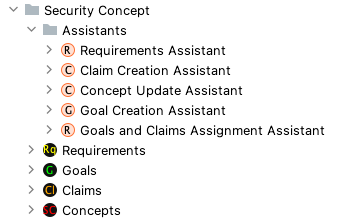
Requirements
A new chunk reflecting Cybersecurity Requirements has been added. A Requirement can be easily added in the same way as all existing security analysis elements and linked with controls or assumptions.
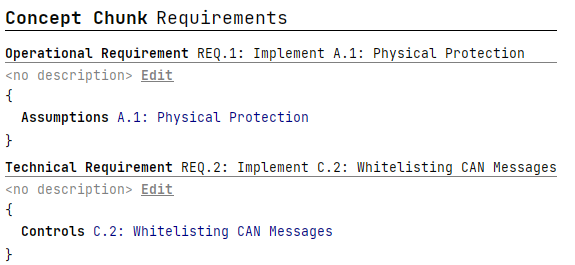
A Requirement consists of a title, name, and a list of elements. The elements can be either Assumptions or Controls. A Requirement has two types, "Operational" and "Technical", determined by the type of elements it contains. An Operational Requirement references Assumptions, while a Technical Requirement references Security Controls. If a user attempts to add different types of elements to one Requirement, a warning will be triggered.
Note: We recommend using our assistants to derive Requirements from existing Controls and Assumptions instead of crafting them manually.
Goals
A new chunk reflecting Cybersecurity Goals has been added. A Goal can be easily added in the same way as all existing Security Analysis Elements.
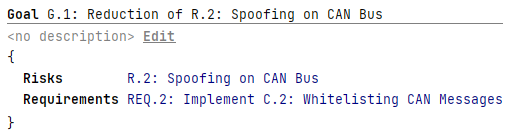
Each Goal comprises a title, name, a list of risks and a list of requirements.
Each assigned risk should be a risk that has been treated as “Reduced”1 in the Risk Treatment chunk; otherwise, a warning will be triggered. Only technical requirements should be assigned to a Goal; otherwise, a warning will be triggered. Cybersecurity Assurance Level (CAL), cause of compromise, and other details are available in the inspector.
Note: We recommend using our assistants to derive Goals from reduced Risks instead of crafting them manually.
Claims
A new chunk type reflecting Cybersecurity Claims has been added. A Claim can be easily added in the same way as all existing security analysis elements.

Each Claim comprises a title, name, a list of risks and a list of requirements.
Each assigned risk should be a risk that has been treated as "Shared, or Retained"2 in the Risk Treatment chunk; otherwise, a warning will be triggered. Only Operational requirements should be assigned to a Claim; otherwise, a warning will be triggered. Cybersecurity Assurance Level (CAL), cause of compromise, and other details are available in the inspector.
Note: We recommend using our assistants to derive Claims from shared or retained Risks instead of crafting them manually.
Security Concepts
A new chunk type reflecting Cybersecurity Concepts has been added. A Concept can be easily added in the same way as all existing security analysis elements.
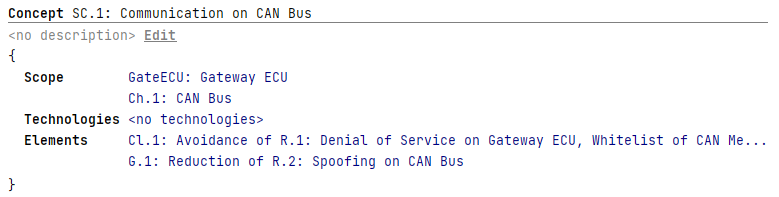
Each Concept comprises a title, name, a Scope (in the form of a list of System Elements), and a list of Technologies, a list of elements (Goals or Claims).
If neither a Scope nor a single Technology is given, the Concept is not limited to a specific subset of all Goals and Claims and is implicitly meant to cover all Goals and Claims.
Note: We recommend using our assistants to populate the Security Concept based on the given scope instead of assigning Goals and Claims manually.