Attack identification
Attack Identification lists the threat scenarios of the TARA. A threat scenario is a potential attack that realizes one or more damage scenarios and is itself carried out through attack steps. The concept is explained in Threat Scenario Identification.
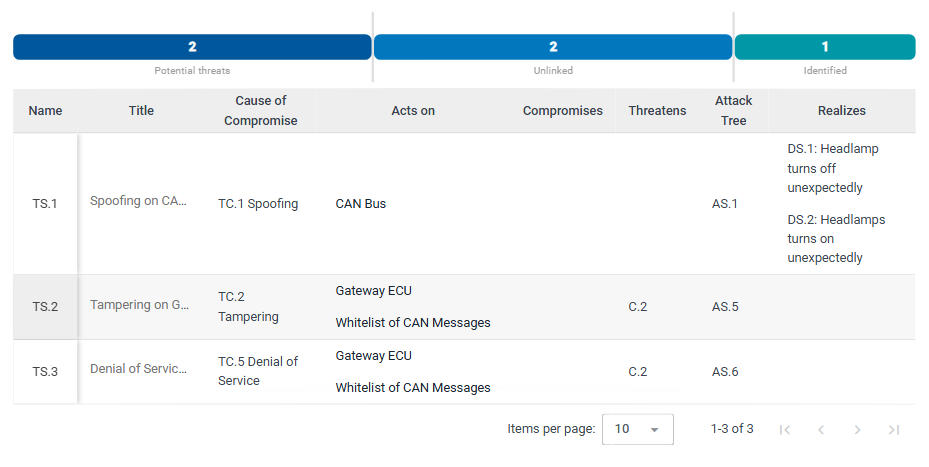
Progress
The progress bar counts:
- Potential threats: damage scenarios that no threat scenario realizes yet.
- Unlinked: threat scenarios that realize no damage scenario yet, that is, whose Realizes Damage Scenarios is empty.
- Identified: threat scenarios that realize at least one damage scenario.
Threat scenarios table
The table has one row per threat scenario: Name, Title, Cause of Compromise, Acts on, Compromises, Threatens, Attack Tree and Realizes. Click a row to open the threat scenario in the element column.
Describe a threat scenario
If you can edit the repository, click + below the table to add a threat scenario. It gets the next free name, for example TS.4, and opens in the element column. Until you give it a title, its title is derived from its threat class and the system elements it acts on, for example "[No threat class] on [No system elements]"; see Derived Titles.
Then fill in the fields of the element column:
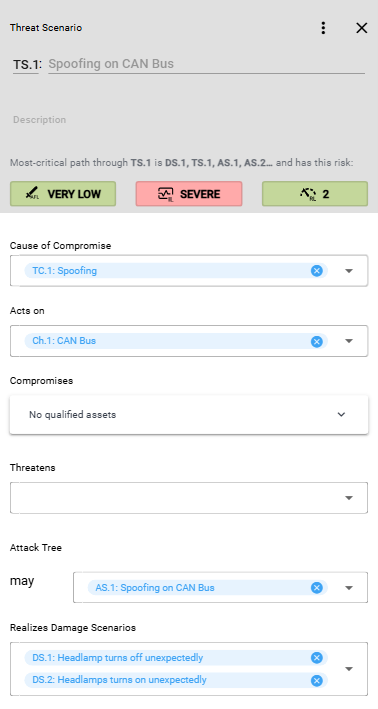
- Cause of Compromise: the threat class of the catalog that this threat scenario instantiates, for example TC.1: Spoofing. If the threat class has feasibility ratings, the threat scenario inherits them. By convention, threat scenarios instantiate threat classes without feasibility ratings, and attack steps instantiate the ones with ratings.
- Acts on: the components, channels, data or data flows the attack is aimed at.
- Compromises: the assets the threat scenario compromises.
- Threatens: other elements of the TARA that this threat scenario threatens.
- Attack Tree: the attack steps that carry out the threat scenario. "may" means that the attacker may choose any one of them. If the attack tree combines the attack steps in another way, for example because it was created in SECURE Desktop, the field shows it as text and you cannot change it here. Attack steps are described on Feasibility Rating.
- Realizes Damage Scenarios: the damage scenarios this threat scenario realizes.