


Whitepapers
Cyber security
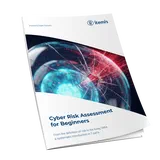
Cyber Risk Assessment for Beginners
From risk definition to a living TARA: a 7-part guide to systematic cyber risk assessment, with direct mappings to CRA, ISO/SAE 21434, and IEC 62443.
Download WhitepaperHolistic protection and seamless traceability for cybersecurity, functional safety, and the Cyber Resilience Act
Overview

Methodological excellence and tailored tools for model-based system and software engineering.
Overview

Enterprise software from a single source: AI integration, legacy migration and full-stack development — cost-efficiently and sovereignly hosted.
Overview

The EU Cyber Resilience Act sets two hard deadlines: from 11 September 2026, reporting obligations apply for actively exploited vulnerabilities and serious security incidents. From 11 December 2027, all products with digital elements must meet the full requirements. Does your product have digital elements and external interfaces? Then it almost certainly falls under the CRA.
The Cyber Resilience Act is the first EU regulation with binding cybersecurity minimum requirements for all connected products on the EU market. It applies across products and industries.
Scope. Products with digital elements are affected: hardware and software with a data connection. The obligations apply to manufacturers, but also to importers and distributors who make such products available in the EU.
Core principles. Security by Design: build security in from the concept phase. Security by Default: secure default configuration at the point of delivery. Lifecycle responsibility: vulnerability management, update management and reporting obligations throughout the entire support period.
Penalties. Violations of the essential cybersecurity requirements can result in fines of up to €15 million or 2.5% of global annual turnover, whichever is higher.
10 December 2024: The CRA entered into force.
11 September 2026: Reporting obligations take effect. Actively exploited vulnerabilities and serious incidents must be reported to ENISA: early warning within 24 hours, full notification within 72 hours, final report no later than 14 days after a remedy is available. → What manufacturers need to build before September 2026
11 December 2027: Full application. All requirements apply to products placed on the EU market, including conformity assessment, CE marking and technical documentation.
Click to switch view
The GAP Analysis checks whether your processes, documents and product characteristics cover the 64 CRA requirements — across seven areas: scope, governance, risk assessment (TARA), product requirements from Annex I, vulnerability management, reporting obligations, and documentation. Each checkpoint is rated on a scale from 0 (not present) to 3 (fully implemented, audit-ready).
The evaluation shows the compliance level per area and makes visible where a dedicated implementation project is needed and where fine-tuning suffices. If the TARA or vulnerability management areas fall below 66 %, a consultation is the next sensible step.
Recommendation: Carry out the analysis together with product management, development and quality assurance, and link supporting evidence directly. Repeat quarterly — this turns it into a progress instrument until December 2027.

CRA GAP Analysis: Free Online Check
17 questions · 7 areas · Radar diagram · No login
Want more depth? 75 checkpoints as an Excel templateThe CRA does not regulate European companies. It regulates products on the European market. If your hardware or software with a data connection is sold in the EU, you carry the full manufacturer obligations — and your EU importers and distributors are legally required to verify your compliance before they place your product on the market.
Most US manufacturers do not start from zero. Security practices built on NIST SSDF, IEC 62443 or FDA premarket documentation already cover part of the ground. We map that existing evidence onto the CRA requirements and close the remaining gaps, instead of running a second, parallel compliance program.
itemis delivers this from both sides of the Atlantic: contracting with itemis Inc. in Chicago, meetings in your time zone, deliverables in English — backed by the compliance team in Germany, in the market where the CRA is implemented, with the CRAIG network for legal and standardization questions. Your contact in the US:
Two of these building blocks reach deep into adjacent topics. The TARA is methodologically part of cybersecurity. → Cyber Security And end-to-end traceability of requirements is mandatory once you need to evidence security requirements across tools. → Requirements Traceability
CRA Risk Analysis: Getting Started with the Excel Template
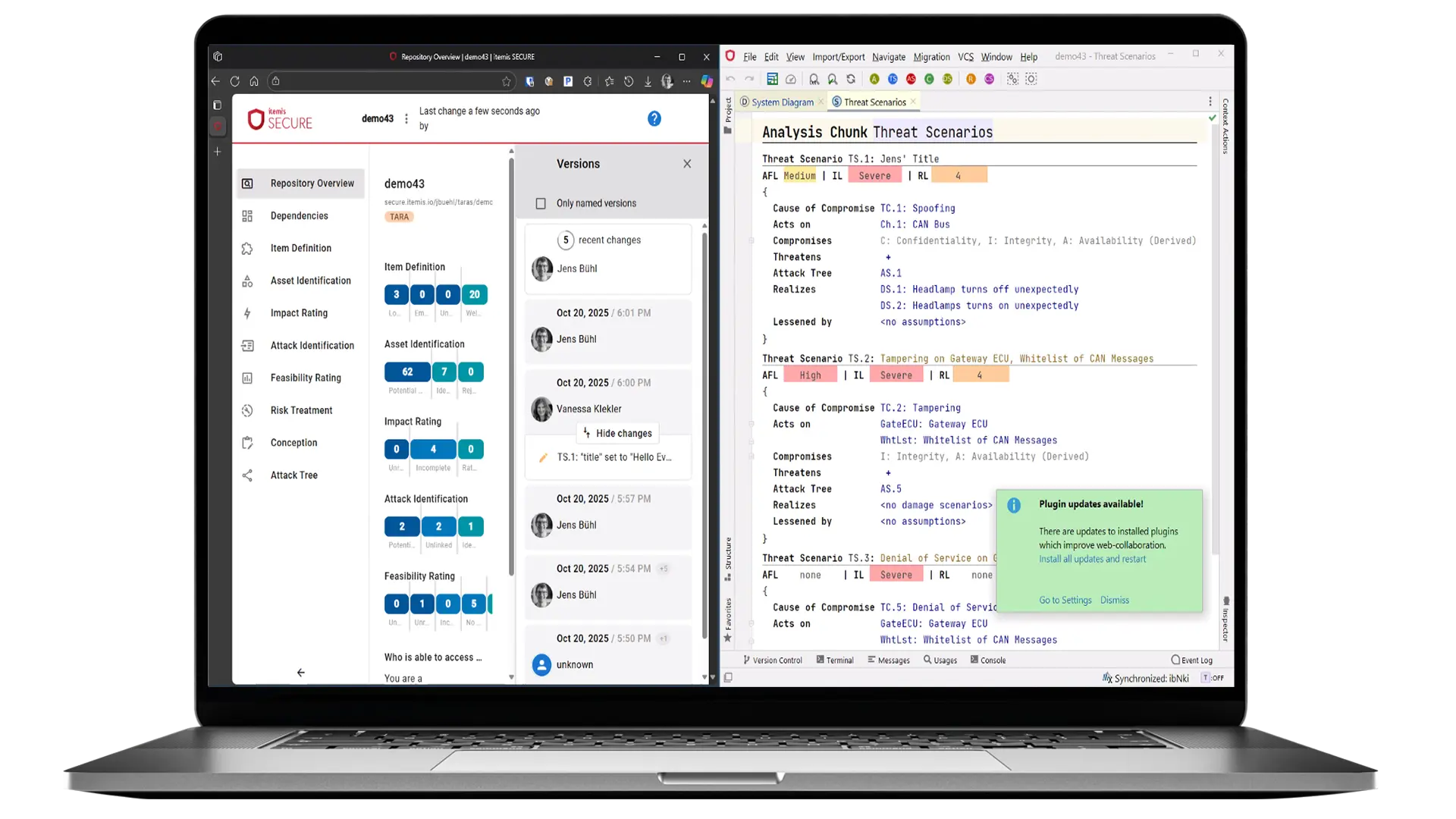
The itemis SECURE Excel template supports the complete TARA process: assets, damage scenarios, threat catalog, attack steps, controls through to threat scenarios and risks. AFL, IL and RL are calculated automatically. The results can be imported directly into itemis SECURE.
Excel · XLSX · Free
In the article: how to work with the templateCRAIG is a non-profit ASBL under Belgian law, founded on 18 March 2026 in Dortmund at the itemis PODIUM. Its mission: to democratise CRA implementation, especially for SMEs with limited resources.
CRAIG bridges the gap between law and technology. Complex regulatory texts are translated into actionable steps. This happens in two ways: through Local Chapters as a personal network on the ground (first locations: Böblingen and Stuttgart, more in the works) and through online tools such as the scope check, a knowledge base and templates.
Any affected organisation can join. Membership is free for individuals. Anyone who wants to can found their own chapter.
The founding team: Dirk Leopold (Chairman), Tim Scherer, Michael Happ, Janine Funke, Hauke Petersen, Max Schubert and Michael Jesse.
itemis is a strategic sponsor and actively supports the Europe-wide network for CRA implementation.

The roles are clearly separated. CRAIG provides community, knowledge and network. itemis SECURE is the platform for technical implementation: model-based TARA, risk assessment and lifecycle management.
How they work together: the community clarifies the WHAT, SECURE delivers the HOW. In itemis SECURE, AI Assistants guide teams through the TARA process, instead of every team starting from scratch in a spreadsheet. The result is a living risk model that updates when new vulnerabilities emerge, not a PDF that is out of date three months later.
Transparency note: CRAIG is non-profit and vendor-neutral. itemis SECURE is our commercial product. We make that distinction openly.

the cybersecurity engineering tool
Each phase is a self-contained entry point. Lifecycle integration is available from the start, not only at the end.
2–5 days from kick-off to results
Security requirements with traceability
Patch documentation and evidence
A single source of truth for all evidence
Schedule a call with Dirk Leopold and Jens Bühl.
From risk definition to a living TARA: a 7-part guide to systematic cyber risk assessment, with direct mappings to CRA, ISO/SAE 21434, and IEC 62443.
Download Whitepaper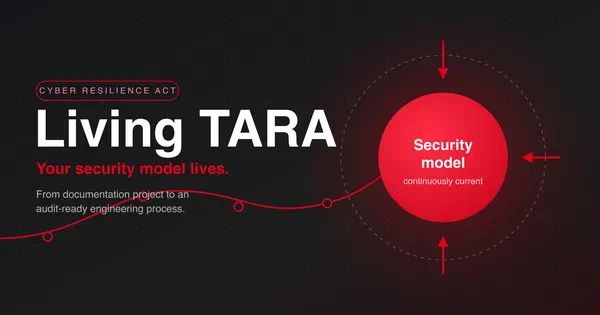
The CRA doesn't ask for a one-time risk analysis — it demands a permanently demonstrable security engineering process. How a Living TARA and the Security Digital Thread keep your risk picture continuously current and audit-ready.
Read Article Dirk Leopold
6 min read
Dirk Leopold
6 min read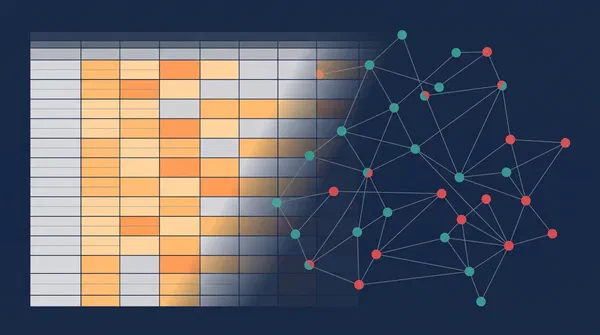
Excel template for CRA risk analysis: TARA in line with ISO 21434 and IEC 62443 — how to start methodically, what you can import, and when Excel becomes the bottleneck.
Read Article Jens Bühl
6 min read
Jens Bühl
6 min read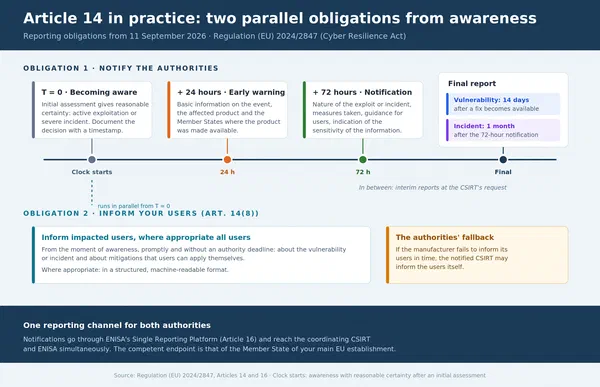
CRA Article 14 reporting obligations take effect on 11 September 2026. This article walks through the complete notification process chronologically — from the initial assessment to the final report — and identifies the points where reporting processes break down in practice.
Read Article
Dirk Leopold
12 min read
Will your product still be legally sellable in Europe after December 2027? This guide shows manufacturers how to approach CRA compliance in 7 structured steps and secure EU market access.
Read Article
Dirk Leopold
5 min read